Coping with labour

Childbirth is a natural process, many women request some form of pain relief during their labour. Various methods are available and it is important that you have an opportunity to find out about them as you prepare yourself for the birth of your baby.
This information will help you prepare for your labour and consider your preferences about pain relief. Every labour is different, and you may find that different options help at different times as your labour progresses. You may wish to use a 'staged approach' starting with the non medical options first. It is therefore best to find out about all the options available to you but keep and open mind and see what happens once you are in labour.
Non-medical options
A back massage can provide pain relief during early labour and when the baby is moving down in established labour.
How to do it
Using thumbs/ knuckles to apply firm pressure in a circular motion to the lower back can provide pain relief and relieve tension.
This is an excellent job for birth partners! It is very normal to change your mind about what you want when you are uncomfortable. For some women, the idea of being touched is not appealing.
Deep breathing is a helpful technique for dealing with pain. It helps you to relax, acts as a distraction and reverses some of the physical symptoms of anxiety.
How to do it
breathe slowly, in for a count of 5, and breathe out for longer equally as slowly. Many people, especially when they are in pain, breathe only from the upper part of their chest. Instead, try taking slow, deep breaths from your stomach. As you breathe out relax your jaw, drop your shoulders and relax your pelvic floor. Consider asking your birthing partner to use positive language and guide you through your breathing.
Hypnobirthing is for all births. Hypnobirthing will provide you with the skills to successfully manage all births, be it Caesareans, induction of labour or situations that are unexpected.
The classes will help you prepare for a more comfortable, calm pregnancy and birth. Focussing on women and their partner's by setting their minds at ease, therefore preparing them with confidence for the birth of their child. The course is just as successful should you not have a birthing partner.
Hypnobirthing uses knowledge of science-based birth physiology and self-hypnosis techniques to reduce the need for pain relief so that you can manage the sensations of labour. Often leading to less or no pain medication and fewer side effects for you and your baby.
• This has been shown to increase your comfort and relaxation during birth
• Reduce fear and anxiety around childbirth
• Allowing you to remain alert and maintain control during labour
• Giving birth partners an active role to play during labour and birth by providing comfort measures and be a great birth partner
The skills learnt can help you enjoy your pregnancy experience and are crucial in the early bonding period after birth. The tools and techniques taught are for life by providing you with a positive mindset and a means to change the way we think.
This can ultimately initiate helpful changes in our lives not just our births.
The classes are generally held over 10 hours and can be run as a group or privately and are recommended to start between 28-32 weeks but can be taken earlier or later too. The classes will cover but not limited to:
• what happens in labour
• upright birth positions
• massage techniques
• deep relaxation skills
• how to personalise your birth space
• what helps birth progress and what hinders it
• how to be a great birth partner
Before you book a hypnobirthing course, please understand that hypnobirthing requires time to practice. There will be techniques for you and your partner to practice at home between classes.
Moving around is a very simple way of relieving pain. Lying in one position when uncomfortable means you are more likely to focus on the pain. Walking is a great distraction from feeling uncomfortable. If rest is needed, using a ball to sit/bounce (or rotate) on is often more comfortable than laying down. Or you could kneel on a mat and lean over the ball resting your head on a pillow. If you want to be on the bed, adopt whatever position feels the most comfortable, for example: all fours, kneeling or laying on your side.


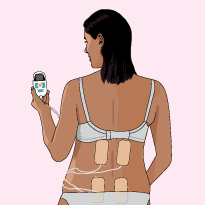
A TENS (transcutaneous electrical nerve stimulation) machine is a small battery-powered device which sends a gentle electrical current though four sticky gel pads that are placed on to your back. Holding this, you adjust the power to allow small, safe amounts of current through the gel pads (it feels like a pulsing ‘buzz’ and should not be painful) You can control the amount of electrical current yourself and can increase it as your contractions become stronger. TENS is reported to be most effective if put on during early labour and is believed to work by stimulating the body to produce more of its own natural painkillers, called endorphins and by reducing the pain signals reaching your brain. The maternity unit supports the use of TENS but does not provide them. You can hire or purchase a TENS machines from chemists.
| Advantages | Disadvantages |
| TENS is non invasive | TENS does not eliminate pain |
| No side effects | Not recommended under 37 weeks |
| Effective when used in early labour | TENS can not be used in a bath, shower or birthing pool |
| Particularly helpful for backache | Not particularly effective in established labour |
Water can provide excellent pain relief. If you find a bath is helpful for period pain/ back ache, then you may find a bath or shower will ease some discomfort in the early stages of labour. Some women find it such excellent pain relief that they choose to birth in water, however this may not be advised for all women.
Frimley Health are delighted to be able to offer complementary therapies in pregnancy and labour. Complementary therapies can include the use of aromatherapy oils via massage and inhalation and pressure point therapy on certain areas of the body, to stimulate contractions and progress labour. These methods can be used in pregnancy as a way of helping labour get started, or, once in labour, can be used to help ease pain, enhance relaxation and progress labour. There are some contraindications to the use of complementary therapies, so speak to your midwife to discuss suitability. We will provide all oils needed for these complementary therapies so do not worry about bringing in your own. Always make sure you speak to a qualified professional about using complementary therapies.
At Wexham Park Hospital we run a complementary therapies clinic to women with uncomplicated pregnancies, who have passed their due date (soon to be implemented at Frimley Park also). This clinic comprises of a full antenatal check, a membrane sweep and an aromatherapy massage with pressure point therapy over a 50 minute appointment (all treatments are optional). This clinic runs weekly. Please ring the Juniper Birth Centre to book in and see if you are suitable for the clinic.
Medical options
Commonly referred to as gas and air, Entonox is a mixture of nitrous oxide and oxygen. You breathe in the gas and air through a mask or mouthpiece. The gas takes about 15-20 seconds to work, so you should start to take slow, deep breathes of it just as a contraction begins and stop breathing it after the contraction has reached its peak.
| Advantages | Disadvantages |
| Easy to use and acts quickly | Entonox can make you feel light- headed for a short time |
| Entonox can be used in the bath, shower or birthing pool | Entonox can cause nausea |
| There are no known disadvantages to your baby | If you take more gas than you need, you may feel tingly. This soon wears off. |
| You are in control of how much Entonox you use |
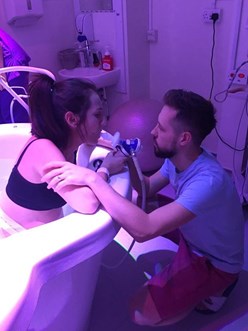
Pethidine is a drug commonly given for pain relief in childbirth during labour; it is a morphine-like painkiller (opioid) given by injection. It takes approximately 20 minutes to work following the injection and the effects last between 2 and 4 hours.
It is not uncommon for a vaginal examination to be recommended prior to administering the Pethidine. The purpose of this is to establish your progress in an attempt to avoid some of the disadvantages listed below that are associated with birth occurring soon after to the time of administration.
| Advantages | Disadvantages |
| Pethidine can make you feel relaxed and drowsy. | Pethidine works better for some people than others. |
| It can be given within a few minutes of your request. | If given too close to your baby being born your baby may be drowsy and slow to take their first breaths. |
| Pethidine can be used on the antenatal ward, labour ward and the birthing centre. | Pethidine can make you feel sick – an anti-sickness drug is usually given at the same time to help avoid this. |
| Pethidine helps to reduce the perception of pain. | Pethidine may make your baby more reluctant to breastfeed in the first 24 hours. |
| You will be unable to use the birthing pool for at least 2 hours following having Pethidine or if you feel drowsy. |
An epidural is a type of local anaesthetic. It numbs the nerves that carry the pain impulses from the birth canal to the brain. An anaesthetist is the only member of staff that can give you an epidural so it is only available on the Labour Ward and not in low risk settings.
| Advantages | Disadvantages |
| It is the most effective method of pain relief. | There are a number of side effects associated with an epidural. |
| It does not cause drowsiness. | It may make your legs temporarily weak or numb limiting your mobility. |
| In doses normally used, the drugs used in an epidural are not known to cause harm to your baby. | You will require a urinary catheter as an epidural causes a loss of sensation from the bladder. |
| An epidural helps to decrease the normal stress response to the pain and effort of labour including raised blood pressure and heart rate therefore it may be beneficial to those with certain medical conditions such as pre-eclampsia. | An epidural may reduce the urge to push and so prolong the second stage of labour. |
| In the event that a forceps, ventouse or caesarean delivery becomes necessary, the epidural providing it is effective can usually be used to provide anaesthesia. | You will require continuous fetal monitoring. |
| It can cause your skin to itch. | |
|
You will require a cannula in your vein |