Reducing your risk of perineal tears
Information copied from Perineal Health in Pregnancy, Birth & Beyond - Antenatal discussion guide OASI2 care bundle to allow for translation.
Full version available here.
What types of perineal tears can occur during childbirth?
During vaginal birth, it is very common to experience a graze or tear of the labia or, more frequently, the perineum, which is the area between your vagina and anus. For most, these tears are minor and heal quickly.
- 1st and 2nd degree: tears that involve muscle/skin that may require stitches
- 3rd and 4th degree: severe tears which extend to the muscles that control the anus (the anal sphincter), requiring stitches. These are also called ‘Obstetric Anal Sphincter Injuries’ (OASI).
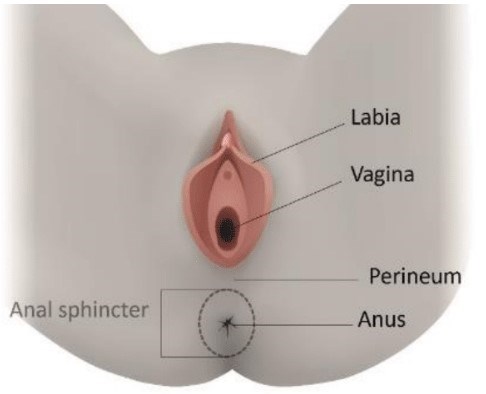
Source: Perineal Health in Pregnancy, Birth & Beyond. Antenatal discussion guide OASI two care bundle.
Severe tears (OASI) occur in 3-4 in 100 births.
You are at significantly higher risk if:
- Forceps are used to help you give birth.
- This is your first vaginal birth
The following may also increase your risk:
- Your baby is born in the back-to-back position
- Your baby is over 4kg (9 lbs)
- You are of South Asian ethnicity
- Your baby is born quickly
- You are over 35
- Your baby’s shoulder gets stuck behind the pubic bone (shoulder dystocia)
- Ventouse is used to help you give birth
- The pushing phase of labour takes a long time
Most women and birthing people who have a severe tear (OASI) repaired recover well, although it can take some time. Occasionally, long-term pain and a difficulty or inability to fully control the bladder, bowels or the passing of wind can occur. This could lead to:
- Feelings of depression, low mood, isolation
- Anxiety about leaving the house and not being able to quickly access a toilet
- Difficulty bonding with baby
- Concerns about leakage while exercising
- Concerns about having sex or giving birth again
If you experience any of the above after birth, contact your doctor or midwife as soon as possible to access specialist care.
Perineal massage with a natural oil (such as coconut or almond) from 35 weeks pregnant until birth, as illustrated here.
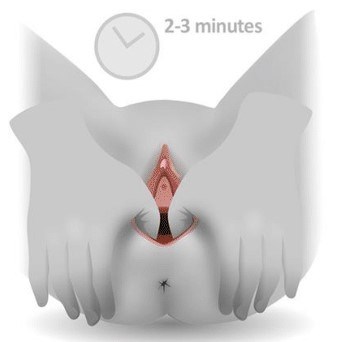
Scroll down to the perineal massage section for more information on how to do this.
A warm compress is a flannel heated with warm tap water and held against your perineum during the pushing phase of labour. Ask your midwife or doctor if they can provide this.
Spontaneous vaginal birth (birth without forceps or ventouse) can be encouraged by choosing the ideal place of birth (consider a homebirth or midwifery-led unit if you are lowrisk), avoiding induction and epidural where possible, creating a relaxing environment (consider soothing lighting, sounds, smells) and remaining active throughout labour and birth.
For first-time mothers with an epidural, lying on your side during the pushing phase of labour is recommended.
Choose a birth position that is most comfortable for you. Listen to your midwife and they will advise a slow and guided birth of the head. Positions at the moment of birth that may reduce risk of severe tears include:
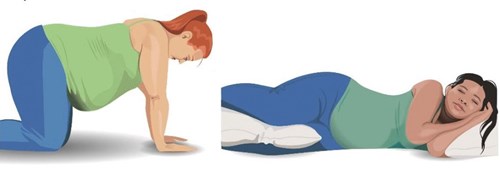
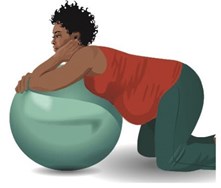
Source: Perineal Health in Pregnancy, Birth & Beyond. Antenatal discussion guide OASI two care bundle.
The OASI Care Bundle is the following set of practices, most effective when applied together:
- In the antenatal period, your midwife or doctor will discuss severe tears (OASI) with you and what can be done to reduce the risk of this occurring.
- With your consent, your midwife or doctor will use their hands to support your perineum and the baby’s head and shoulders during birth and encourage a slow and guided birth.
- You may need an episiotomy—a cut through the vaginal wall and perineum to make more space for your baby to come out—your midwife or doctor will ask for your consent to do this.
- After your baby has been born, your midwife or doctor will ask for your consent to examine your vagina, perineum and anus (just inside the back passage) to ensure any tears are identified and appropriately treated to avoid further consequences.
- Developed by experts
- Supported by women
- Found effective in a 2017-18 study (OASI1)
For more information on perineal massage please see Reducing your risk of perineal tears | RCOG
From 35 weeks onwards you may choose to try perineal massage until your baby is born, which has been shown to reduce the risk of tears. This is particularly beneficial for first-time mothers. You may wish to ask your partner to help with this.
To complete perineal massage:
- Use a lubricant such as vitamin E oil, coconut oil, almond oil or olive oil.
- Hold one or both of your thumbs in the position shown for about one minute. You will begin to feel a stretching sensation. Keep breathing.
- Gently massage the lower half of your vaginal opening using a U shaped movement for 2-3 minutes. Do this 2-3 times.
- Repeat the massage daily, or when possible.
Source: Perineal Health in Pregnancy, Birth & Beyond. Antenatal discussion guide OASI two care bundle.
More information and videos are available here
LICENSE NOT FOUND OR INVALID
Please speak to your midwife or doctor if you have any questions.
For more information and support, visit: