Frequently asked questions
Yes, updated guidance recommends qrisk3.
The guidance states: until electronic clinical systems in which QRISK2 is embedded are updated with QRISK3, it may be necessary to use QRISK2. When assessing risk for people taking corticosteroids or atypical antipsychotics or people with systemic lupus erythematosus, migraine, severe mental illness or erectile dysfunction, use QRISK3 (the online version of QRISK3, if necessary) because QRISK2 does not take these risk factors into account and so may underestimate the 10‑year CVD risk in these populations.
Consider statin therapy for patients with >10% CVD risk using QRISK. We're talking about large populations so a pragmatic approach would be to prioritise patients with >20% CVD risk.
NICE suggests prioritising people for a full formal risk assessment if their estimated 10-year risk of CVD is 10% or more.
NICE also recommends considering using a lifetime risk tool such as QRISK3-lifetime to inform discussions on CVD risk and to motivate lifestyle changes, particularly for people with a 10-year QRISK3 score less than 10%, and people under 40 who have CVD risk factors. (NICE CKS: Scenario CVD risk assessment)
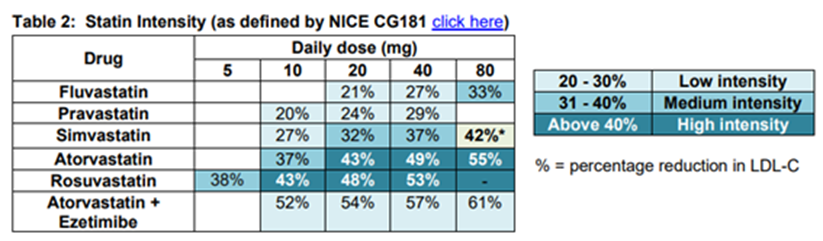
Yes. Ezetimibe should be considered if statins are contraindicated, not tolerated or maximum tolerated dose of the statin does not achieve the required reduction in non-HDL-C or LDL.
Ezetimibe when combined with any statin is likely to give greater reduction in non-HDL-C or LDL-C than doubling the dose of the statin.
Use the NHS Accelerated Access Collaborative » Statin intolerance pathway (england.nhs.uk) to confirm true statin intolerance.
If statin intolerance is confirmed, consider ezetimibe 10mg monotherapy. Assess response after 3 months (TA385). Consider ezetimibe 10mg and bempedoic acid 180 mg in combination when ezetimibe alone does not control LDL sufficiently. (NICE TA694).
Alirocumab (NICE TA393), Evolocumab (NICE TA394) (both only available through secondary care) and Inclisiran (NICE TA733) may also be considered if statins are contraindicated, or not tolerated or maximum tolerated dose of the statin does not achieve the required reduction in LDL but only in patients with established CVD (i.e., secondary prevention)
Deprescribing is a clinical judgement and should be in the best interest of the individual patient. There is some general guidance to support this clinical decision-making. (Coronary heart disease and risk management in frail older people – SPS - Specialist Pharmacy Service – The first stop for professional medicines advice).
IN FAVOUR OF DEPRESCRIBING
- End of life – lipid modifying medicines should generally not be initiated in patients with a life expectancy <2years.
- Low Cardiovascular Event Risk - patients with a lower cardiovascular risk have a lower absolute benefit from statins (i.e. a larger number needed to treat). Estimated lifetime risk of CVD
- Presence or risks of adverse effects
- Poor overall functional status - patients who are less independent and frailer tend to have a poorer prognosis and the benefits of statin therapy may be less relevant in this setting.
- Patient preferences
- Breastfeeding Using lipid-lowering medicines during breastfeeding – SPS - Specialist Pharmacy Service – The first stop for professional medicines advice
- Intolerance (e.g., NHS Accelerated Access Collaborative » Statin intolerance pathway (england.nhs.uk)
AGAINST DEPRESCRIBING
- Secondary prevention - patients who are well and functionally independent and have a reasonable life expectancy, with a very high risk of recurrent events (i.e., a recent ACS, ischaemic stroke, severe PAD, coexisting poorly controlled diabetes, severe renal dysfunction) should be considered for ongoing statin therapy.
If cessation of statins is appropriate, they can be stopped without the need for dose tapering. We can now offer patients more options to reduce their cholesterol with the advent of novel therapies. Declining treatment remains an option which is valid, particularly if the patient is well informed – education is key here.
Yes, if they meet the criteria for inclisiran refer to local guidance)
Statins and liver Function
- If ALT or AST are > 3 times the upper limit of normal (ULN) then do not initiate a statin or discontinue statin therapy already prescribed and repeat the LFTs in a month. If LFT’s return to baseline or are < 3 times ULN, restart with lower dose/alternative statin. Repeat ALT or AST in 1 month.
- If LFTs remain high off statin therapy, look for other causes. The only lipid-lowering therapy that can be considered in this situation are bile acid sequestrants (e.g., colestyramine etc), PCSK9-inhibitors, and inclisiran, if the patient qualifies for any of these medicines.
- If the ALT subsequently falls, a statin could be re-tried provided the LFTs are monitored.
NICE recommends a baseline transaminase level before starting a statin. In practice and after discussion with the project steering group, we both would use a level that was taken up to six months before, if we had no other clinical concerns.
NICE states: Before offering statin treatment for primary prevention, discuss the benefits of lifestyle changes. Offer people the opportunity to have their risk of CVD assessed again after they have tried to change their lifestyle. Do not rule out treatment with atorvastatin 20 mg for the primary prevention of CVD just because the person's 10‑year QRISK3 score is less than 10% if they have an informed preference for taking a statin or there is concern that risk may be underestimated. NICE also suggests using a lifetime QRISK calculator (https://qrisk.org/lifetime/), if QRISK3<10%. Cholesterol retesting to check improvement in levels can be done between 8 and 12 weeks after starting treatment.
A search (outlined below) does not highlight a concern that long term statin use is a risk factor for bladder cancer. The conclusions of published reviews and meta-analyses are not consistent.
Detailed information on the resources we have used to answer:
SPCs for statins do not mention bladder cancer as a recognised nor suspected adverse effect (eMC).
BNF (simvastatin) There is no information in the BNF linking statins to bladder cancer.
Martindale (simvastatin monograph) includes the following (note that this section was last modified in 2009):
Malignant neoplasms (Latest modification: 05-Oct-2009).
Although studies in animals suggest that statins could be carcinogenic, evidence for a detrimental effect in humans is limited, and some studies have suggested that statins may be protective. Low plasma-cholesterol concentrations have been associated with cancer, and an increased incidence of cancer was reported in a randomised study of pravastatin for cardiovascular risk reduction in elderly patients, although this was attributed to chance. Conversely, several observational studies have reported that statins reduce the incidence of cancer, although the effect has generally been small. Meta-analyses have generally found no association between the use of statins and the incidence of cancer. Analyses including only randomised studies have found no significant effect on overall risk, although follow-up may not have been long enough in most studies to be conclusive; there is also little evidence of a protective effect for specific cancers. However, another large cohort study in elderly patients found no evidence that statins either increased or reduced the risk, and longer follow-up in a randomised study using simvastatin also found no significant effect.
AHFS Drug Information. The simvastatin monograph from this American text states:
While early animal studies raised concerns of possible carcinogenic properties of simvastatin, a large body of evidence indicates that long-term statin therapy is not associated with an increased risk of cancer.
Meyler’s Side Effects of Drugs. The simvastatin monograph states:
In the SEAS trial simvastatin 40 mg + ezetimibe 10 mg was compared with placebo in 1873 elderly subjects with mild to moderately severe aortic stenosis. The hypothesis was that intensive lipid lowering would reduce the rate of progression of stenosis. The result over 4.1 years did not support the hypothesis, despite a 50% reduction in LDL cholesterol. However, there was a statistically significant increase in the incidence of cancers (93 versus 65 cases in the placebo group). There were several types of cancer but no temporal relation between therapy and diagnosis. Nevertheless, this led to further interim investigations in two larger studies of the combination of simvastatin + ezetimibe, the SHARP trial and the IMPROVE-IT trial. Analysis of the incidences of cancers in all three trials established an overall absence of increased cancer risk compared with placebo in SHARP and compared with simvastatin alone in IMPROVE-IT. The rates of some cancers rose slightly but the rates of others fell. A very large post-marketing survey based on cancer adverse event reports filed with the FDA did not show excess cancer rates linked to 52 million prescriptions for ezetimibe and 55 million prescriptions for ezetimibe + simvastatin.
UpToDate
The monographs describing epidemiology and risk factors for bladder cancer did not mention statins. However, the monograph Statins: Actions, side effects, and administration (NHS Athens required) states:
- Cancer– There is no convincing evidence from meta-analyses of randomized trial that statins increase or decrease the risk of cancer.
Statin eligibility for primary prevention using ACC/AHA criteria may predict cancer risk and mortality. In a Framingham Heart Study analysis, the incident cancer rate was 15 percent in the statin-eligible group compared with 8.8 percent in those who were ineligible (HR 1.8, 95% CI 1.4-2.3).
Cancer-related deaths occurred in 4.2 percent of the statin-eligible group compared with 0.4 percent in those who were ineligible (HR 12.1, 95% CI 4.7-31). In a stratified analysis, these findings were independent of known cancer risk factors such as increased body mass index, increased age, and smoking history. While the explanation for this observation is unclear, these results suggest that factors contributing to statin eligibility may also be predictive of an increased risk of cancer.
Clinical Knowledge Summaries (NICE) summaries Lipid modification and Urological cancers - recognition and referral do not mention an association between bladder cancer and statins.
BMJ Best Practice. Within the aetiology section of the Bladder Cancer monograph (NHS Athens required) there is no mention of statins as being a recognised causative factor.
Cochrane Library. There are no Cochrane reviews addressing bladder cancer risk with statins.
Literature search
The following references were retrieved:
In this large population-based case-control study, prolonged use of statins was not associated with an increased risk of cancer at any of the most common sites except for colorectal cancer, bladder cancer and lung cancer, while there was a reduced risk of haematological malignancies.
The present data do not provide evidence to support either beneficial or harmful associations between statin use and bladder cancer risk.
The findings of this meta-analysis suggested that there was no association between statin use and risk of bladder cancer. More studies, especially RCTs, are needed to confirm this association.
- The association of statin use with risk of kidney, bladder and prostate cancer: a systematic review and meta-analysis of cohort studies (2018) (attached)
The results found that sex difference could affect the association of statin use with the risk of kidney cancer. The statin use could reduce the risk of prostate cancer but no associations were found between statin use and bladder cancer.
- Association between occurrence of urinary bladder cancer and treatment with statin medication (2019)
This nationwide register study suggests an association between the occurrence of UBC and patients using statins. The association was found in patients with non-muscle invasive disease only. Confounding factors, such as smoking, cannot be overruled.
This study provides additional evidence for inverse associations between lipid-lowering drug use and cancer incidence and mortality but a positive association with bladder cancer incidence in men. Evaluation of the impact of chemoprevention strategies that include lipid-lowering drugs on population-level cancer burden is needed.